How to Vibe-Code Chizhik-Pyzhik
We live in interesting times. People are used to the idea that programmers are purely technical folks. Large language models turn into programmers anyone who can express thoughts clearly, in speech or writing. In that sense, humanities people can now program too.
Let’s test this on a small app that plays the Chizhik-Pyzhik melody and draws a color-music visualization.
Step-by-step instructions
🦡 Draw by hand how you imagine the visualization.
🦡 Prepare a melody file.
🦡 Describe the application.

A few comments here. Some things are important, some are not. For example, having the specification in Markdown is important. LLMs know this format well, and block structure works in your favor. Having too many details is less important. This is my second time running this experiment; I had requests from the first run and wrote them down. A pretty good result can be achieved even if the text is about three times shorter.
🦡 Start Codex and ask it to produce a full detailed plan of what it is going to do. This matters a lot. It is like dealing with a tricky genie: it does exactly what you asked, but the result is still not what you wanted. Reviewing the detailed plan is your chance to catch the trickster and add corrections.
🦡 Literal prompt:
“Read task_description_00.md, create a detailed plan of what you are going to do, and put it into detailed_plan_00.md.”
Resulting detailed plan.
🦡 While reviewing the plan, I saw the line “Repeat |: ... :| is respected: the phrase plays 2 times.” I didn’t need that, so I removed it.
Overall, I liked the plan, but the sector behavior still looked unclear. I clarified it once more and got this document.
Instruction:
“In the current plan it is not clear what happens with sectors when a note is played multiple times. Sectors accumulate, new ones are added from the inside. Apply the correction in a new file detailed_plan_01.md.”
🦡 Now the plan looked good, so I asked it to write the app and deploy to GitHub Pages. It is not super fast - Codex is not in a rush - but quality is high. Compared with Claude, Claude usually finishes much faster, but can forget some details from your request. In about 10 minutes, Iron Friend produced 853 lines of code. Preparing the “order” for this project took about an hour: draw the image, think through the spec, write text, and review the first plan.
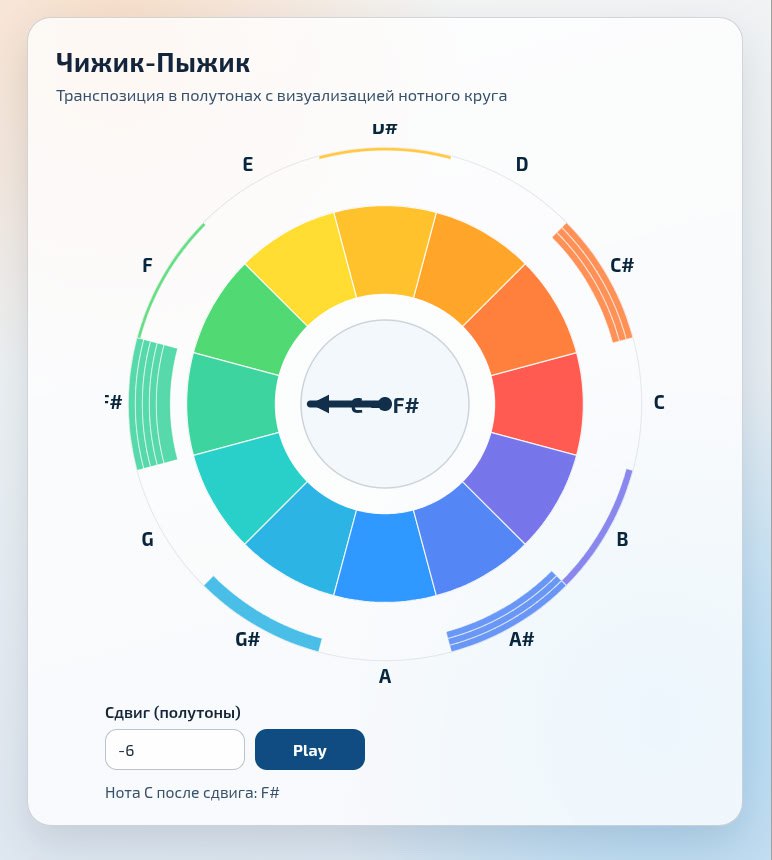
Application - first-run result.